

Two-minute review
The OnePlus 8 Pro is a proper flagship phone. Forget previous generations of handsets from the firm, and its 'flagship killer' underdog mantra. OnePlus is now officially mixing it with the biggest names in mobile.
Whereas handsets such as the OnePlus 7 Pro and 7T Pro cut a few corners in order to hit a slightly lower price tag than the competition, the OnePlus 8 Pro isn't pulling any punches – it’s now genuine competition for the likes of the Samsung Galaxy S20 Plus, iPhone 11 Pro and Huawei P40 Pro.
Unfortunately, the arrival of the OnePlus 8 Pro also means that the days of OnePlus offering an 'affordable flagship' option are over. But for that pricetag, you'll get top-tier specs and features – as well as 5G connectivity.
Update: The OnePlus 8 Pro is now available in the UK/Europe and US. Scroll down for pricing and availability in all regions.
ONEPLUS 8 PRO SPECS
OnePlus has slapped the best display it's ever made on the 8 Pro, and the Chinese company goes as far as to say it's the best screen you'll see on a phone all year.
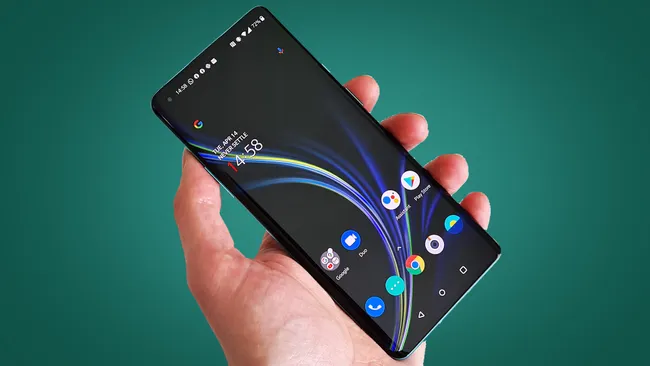
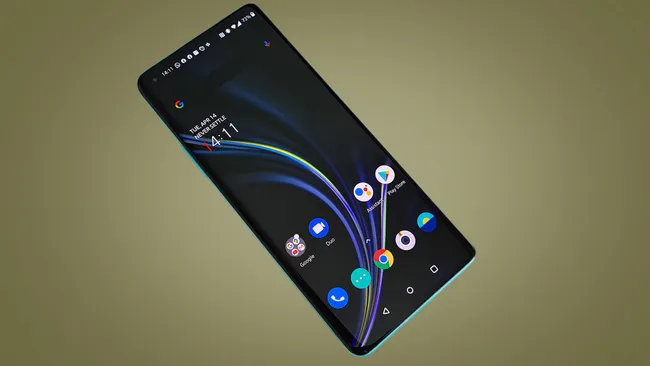
It's a bold claim, and one which may prove unfounded as the year goes on, but take nothing away from this handset: the 6.78-inch 'Fluid Display' with a 120Hz refresh rate, HDR10+ support and QHD resolution is fantastic.
There's a quad camera setup on the rear providing a wealth of photography options through features such as an ultra-wide-angle lens, 30x zoom, powerful night mode, and the firm's new 'color filter' camera that’s designed to give your shots a unique look.
While the cameras are a marked improvement over the snappers on the 7 Pro and 7T Pro, they don't quite hit the same heights as Samsung, Huawei or Google. They are still very good, though.
OnePlus has also, finally, given its fans what they've been asking for by including their most-requested feature: wireless charging.
Not only that, but it's fast wireless charging too, with the ability to get you from zero to 50% in just 30 minutes. The 8 Pro also features the biggest battery ever in a OnePlus phone, and it'll easily last you a day on a single charge.
Add to that the flagship power under the hood that we're used to seeing from OnePlus, with the top-of-the-line Snapdragon 865 chipset teamed with either 8GB or 12GB of RAM, plus the addition of 5G connectivity to both the 8 Pro and its smaller sibling, the OnePlus 8, and it's clear the brand is no longer willing to take a backseat when it comes to any of its specs.
In short, you've got a highly accomplished flagship smartphone on your hands that will even connect to next-gen 5G networks..
OnePlus 8 Pro release date and price
- OnePlus 8 Pro price: $899/£799 (8GB+128GB) | $999/£899 (12GB+256GB)
- OnePlus 8 Pro pre-orders open: April 14, 2020 (UK and Europe)
- OnePlus 8 Pro release date: April 21 (Europe), April 29 (US)
The OnePlus 8 Pro is the most expensive OnePlus smartphone to date. That's not a surprise, as the company has been increasing prices each year to keep pace (and arguably, catch up with bigger increases) with the rest of the market; however, it means the brand is losing the 'affordable flagship' pull which made it a breakthrough success back in the days of the OnePlus One and OnePlus 2.
The OnePlus 8 Pro price starts at $899 / £799 (around AU$1,500) for the 8GB of RAM and 128GB of storage variant. That's £100 more than the OnePlus 7T Pro starting price, and you're getting half the amount of storage in the new 8 Pro (vs 256GB in it predecessor). On the plus side, though, the 7T Pro was only a 4G phone, while the 8 Pro has 5G connectivity.
There are two variants of the OnePlus 8 Pro, with the pricier option setting you back $999 / £899 (around AU$1,700) and bagging you 12GB of RAM and 256GB of storage. That's £100 more than the 'McLaren Edition' of the 7T Pro, which also came with a 12GB+256GB configuration and was 5G enabled.
While OnePlus fans may be a little alarmed by the OnePlus 8 Pro price, it remains cheaper than its top-tier competition: the Samsung Galaxy S20 Plus comes in at $1,199.99 / £999 for 128GB, while the iPhone 11 Pro starts at $999 / £1,049 for 64GB and jumps to $1,149 / £1,199 for 256GB.
The 8 Pro launch date was April 14, with an online reveal in lieu of an on-stage launch event in light of the current global crisis, and pre-orders for the new phone are currently open in the UK and Europe.
The OnePlus 8 Pro release date is set for April 21 in the UK (and Europe), with the handset available from OnePlus, Three UK, Amazon and John Lewis.
In the US, you're looking at a OnePlus 8 Pro release date of April 29, with the handset available to buy from OnePlus, Amazon, T-Mobile and Verizon.
The OnePlus 8 Pro will be available in a number of other global markets, including Canada, India, China and a further 27 European countries.
Display
- 6.78-inch, 1440 x 3168 QHD+, 19.8:9, 513ppi, 120Hz, HDR10+
- OnePlus says its 'Fluid Display' is "the best screen you'll see all year"
- High refresh rate and video upscaling are great for gaming and video
The biggest talking point from OnePlus around the OnePlus 8 Pro is its 'Fluid Display'. The firm is extremely proud of what it's equipped the handset with, so much so that it claims this is "the best screen you'll see all year".
While that claim is a little premature, coming as it does just four months into 2020, it's fair to say that the OnePlus 8 Pro display is one of the best we've seen on a smartphone.
Its 6.78-inch size, 1440 x 3168 QHD+ resolution, tall 19.8:9 aspect ratio and 513ppi pixel density are par for the course when it comes to flagship smartphones these days, but the OnePlus 8 Pro panel goes further.
Refresh rate is quickly becoming a go-to spec for many phone manufacturers. In a trend that was kick-started by the Razer Phone and its 120Hz screen back in 2017, we've seen a number of manufacturers bring higher refresh rates to their handsets
The benefits of a higher refresh rate include smooth scrolling in apps, and better graphical fluidity in games, which overall provide a more premium experience.
Looking at recently released phones, the Huawei P40 Pro, Google Pixel 4 XL and OnePlus 7T Pro all pack 90Hz screens.
The Samsung Galaxy S20 Plus meanwhile, has 120Hz max settings, although it's not set to this by default – enabling 120Hz on these devices will see resolution drop from QHD+ to Full HD+ in order to preserve power.
Where the OnePlus 8 Pro differs is that 120Hz is switched on by default, although at 'only' Full HD+. However, dive into the settings and you can switch to 120Hz at the higher QHD+ resolution (this is also possible on the Oppo Find X2 Pro).
OnePlus says it's done a lot of optimization work to try and ensure battery life is preserved while still offering the maximum resolution and refresh rate – and based on our time with the phone it appears that this has paid dividends. Battery drain at QHD+ and 120Hz is slightly faster than at the lower-resolution setting, but the difference is minimal from our experience of gaming and watching video.
OnePlus isn't done there though. Independent screen tester DisplayMate has awarded the OnePlus 8 Pro an A+ grade, with the handset offering an industry-leading 1300 nits peak brightness and top-level color accuracy.
What all of this means is everything looks great on screen. From photos and websites to videos and games, the OnePlus 8 Pro packs color and detail, and offers excellent viewing angles.
When it comes to video playback, content can be enhanced further with two additional settings – you can switch on 'vibrant color effect pro' and 'motion graphics smoothing' for a richer viewing experience.
'Vibrant color effect pro' optimizes the colors and contrast in videos to provide a more vibrant picture, which is noticeable in especially colorful shows and films, and will please those who like a little more 'pop' from their picture.
Meanwhile, 'motion graphics smoothing' increases the frame rate of the video for clearer playback. This mode only works for select apps (including Gallery, YouTube, Netflix and Prime Video), and when the video in these apps is made full screen. By increasing the frame rate, movements become smoother, but whether or not you like the result will be a matter of personal taste.
Some will enjoy the ultra-smooth playback, and it's impressive to see just what the technology is capable of, as it works well; for others, though, movements may appear a little unnatural and off-putting. We watched a variety of shows and movies with 'motion graphics smoothing' on, and in scenes where there’s a lot of crowd movement people can look like they're a little too fluid.
Both of these settings are turned off by default, so if you're not a fan of how they adapt your viewing experience it's easy enough to leave them off.
One slight issue we did have with the OnePlus 8 Pro display was false touches. Where some handsets have 'palm rejection' which detects when your hand is resting on the side of the display and not trying to interact with it, the 8 Pro doesn't and this means your palm is sometimes mistaken for a touch input.
It doesn't happen all the time, but it can be frustrating when you're playing a game and the 8 Pro mistakes your palm or supporting finger for a touch command. We'll take any excuse we can when we lose.
Design
- Premium finish looks and feels great
- First OnePlus phone with an IP rating for dust and water resistance
- Sizable camera bump is easy to knock if you don't have a case
The OnePlus 8 Pro looks like most other high-end smartphones. The front is dominated by the large 6.78-inch display which curves over each vertical edge, with the front and rear glass sandwiching a metal frame that runs around the circumference of the body.
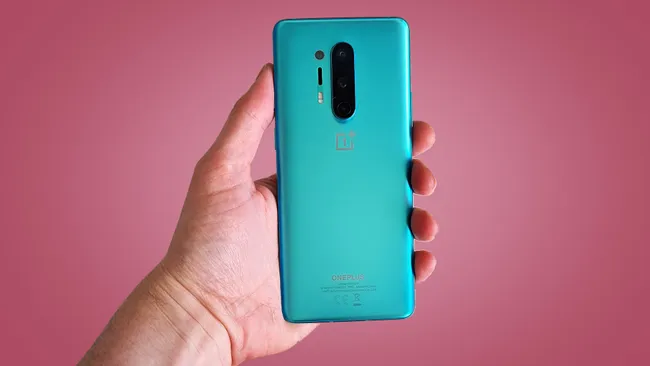
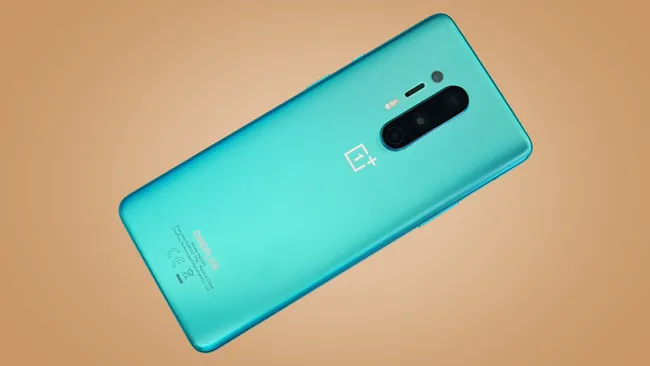
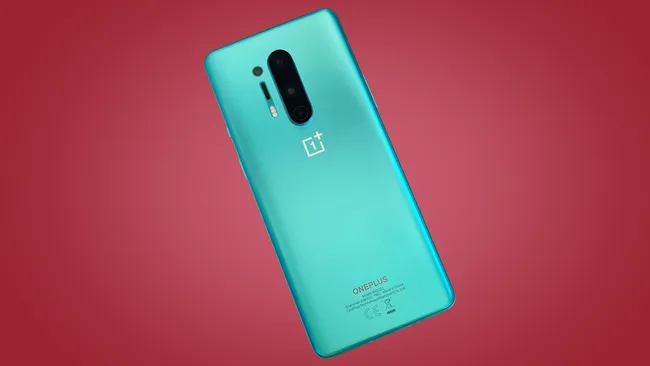
Our review unit came in Glacial Green, and along with the Ultramarine Blue option, it boasts a matte-frosted Gorilla Glass on the rear, which is smooth and inviting to the touch.
It feels more tactile than the glass on the rear of the Galaxy S20 Plus and iPhone 11 Pro, and enhances the feel of the phone in the hand. It doesn’t provide much in the way of grip though, and the 8 Pro can be a little slippy.
Of course, that won’t be an issue if you opt to slip the OnePlus 8 Pro into the translucent silicone case that’s included in the box. This detracts from the premium aesthetic, as any generic case does, but you can at least still see the fetching green color – and it provides protection for the sizable camera bump protrusion.
We’d recommend utilizing the case if you’re someone who isn’t overly careful with their smartphone. The camera bump is noticeable whether or not you have the case on, and we sometimes found ourselves catching our fingers on it.
The vertical camera stack in this bump is par for the course design-wise – pretty much every manufacturer has enlarged its camera housing recently, so it’s difficult to mark the OnePlus 8 Pro down too much here.
At 165.3 x 74.35 x 8.5mm the OnePlus 8 Pro is a large handset, and many users will find that two hands are required to hold it securely. It’s taller and wider than the Galaxy S20 Plus, P40 Pro and iPhone 11 Pro – although it does have a larger screen than all three – while weight-wise it sits in the middle of the pack at 199g.
There’s just one port on the 8 Pro, and that’s the USB-C port on the base – there’s no 3.5mm headphone jack here. This is flanked by the dual-slot SIM tray and a speaker (one of two on the phone), the latter of which can be muffled by your hand when gaming or watching video when the phone is held in landscape orientation.
The power/lock key is on the right of the handset – a double-press of this will launch the camera, while a long press will fire up Google Assistant. Above this is OnePlus’ handy alert slider, which enables you to quickly switch between silent, vibrate and sound-on modes; a textured finish makes it easy to locate and slide.
On the left side are the volume keys, which are easy enough to reach when you’re holding the phone one-handed, although those with smaller palms may find themselves shuffling the 8 Pro slightly in order to hit volume up.
One feature that was on the 7 Pro and 7T Pro, but which OnePlus has dropped here, is the pop-up selfie camera, with the OnePlus 8 Pro featuring a circular punch-hole camera cutout in the top-left corner of the screen instead.
It’s the first time OnePlus adopted this design for the front-facing camera, and it says it’s made the switch because ditching the moving mechanism frees up space inside the phone and reduces the weight.
The punch-hole measures just 3.8mm in diameter, which means it doesn’t take up too much space – notifications sit comfortably beside it, and in day-to-day use we generally forgot it was there.
The OnePlus 8 Pro is the first handset from the brand to carry an official IP rating, which means it’s officially protected against dust and water. While previous generations have been dust- and water-resistant, OnePlus has never supplied an official rating.
With a rating of IP68, the OnePlus 8 Pro is protected against total dust ingress, and against submersion in up to one meter of water for 30 minutes – which means you should be okay if your phone takes an accidental dunking in the bath.
The OnePlus 8 Pro is available in three colors; Glacial Green, Onyx Black and Ultramarine Blue. In the UK you’ll only be able to pick the 8 Pro up in the green and black hues, while we’re still waiting to hear which colors will be available in other countries.


Aucun commentaire:
Enregistrer un commentaire